
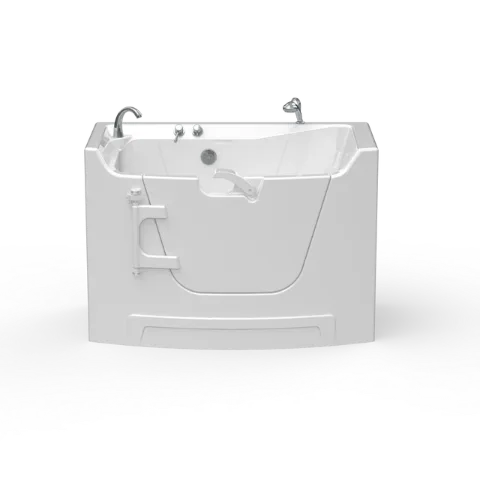
How a transfer tub differs from a standard walk-in tub
A standard walk-in tub has a narrow door and a low threshold you step over, usually while standing. That works for someone with a cane or walker. It does not work for someone who cannot stand.
A transfer tub changes the geometry. The door is wide, often L-shaped, and swings out and away. With it open, the edge of the seat is exposed at roughly wheelchair height. The bather sits, swings their legs in, and the door closes behind them. There is no moment of standing on a wet floor.
| Feature | Standard walk-in tub | Wheelchair transfer tub |
|---|---|---|
| How you get in | Step over a low threshold, then sit | Slide sideways from the wheelchair onto the seat |
| Door | Usually narrow; inward or outward swing | Wide, outward swing, opening to seat height |
| Standing required? | Briefly, to step in and turn | No, if the transfer is a seated slide |
| Floor space in front | Room to stand and step | Room to park a wheelchair parallel to the seat, and for the door to swing |
| Best for | Cane and walker users, people who can stand briefly | Wheelchair users who can sit unsupported and slide |
Is a transfer tub right for you? Five questions
- Can you sit upright without support for 20 to 30 minutes? You will be seated while the tub fills, during the bath and while it drains.
- How do you move from your chair to a bed or car today? If you slide sideways, alone or with a board, the same move works into a transfer tub. If you need a stand-pivot with help, it can still work with one trained helper. If you need a lift, see the section on lifts below.
- Which side do you transfer toward most easily? Transfer tubs come with the door hinged on the left or right. Order the side that matches how you move, not the side that is easiest for the plumber.
- Can you lift your legs over the inner lip, or will someone help? Many people lift one leg at a time with their hands or a leg lifter strap once they are seated.
- Do you have reduced feeling in your legs? If so, water temperature control is a safety feature, not a comfort extra. The ADA caps tub spray units at 120°F (49°C), and MedlinePlus advises setting the water heater no higher than 120°F.
Transfer techniques, step by step
An occupational or physical therapist should teach and check the method you use. The steps below are general and follow the MedlinePlus instructions for moving a person from a bed to a wheelchair, adapted to a tub seat. Practice with the tub dry and the door open before the first real bath.
1. Seated sliding transfer (with or without a transfer board)
- Park the wheelchair parallel to the tub seat, or at a slight angle, as close as the open door allows.
- Lock both brakes and swing the footrests out of the way.
- Remove or flip up the armrest on the tub side.
- If you use a transfer board, set one end under your thigh and the other on the tub seat.
- Scoot forward a little in the chair, plant your feet, and slide across in two or three short moves rather than one big one, pushing with your hands.
- Once seated, lift each leg over the lip into the tub, then close and seal the door.
2. Stand-pivot transfer with one helper
MedlinePlus is clear that this method is for a person who can stand on at least one leg. The key safety points carry straight over to a tub:
- Clear loose rugs and use non-skid socks or shoes on the bathroom floor.
- Lock the wheelchair brakes and move the footrests aside.
- The helper uses a gait belt if one is available, keeps their back straight and bends at the knees.
- The bather keeps their hands at their sides or on the chair to push up, and does not wrap their arms around the helper's neck.
- Pivot on a count of three, and lower to the seat when the backs of the legs touch it.
- If the bather starts to fall, lower them to the nearest flat surface rather than trying to hold them up.
3. Mechanical lift
MedlinePlus advises using a lift when the person cannot use at least one leg. A ceiling track or portable floor lift can lower a bather onto a tub seat, but the tub has to leave room for it. Some transfer baths have a removable lower panel so the base of a floor lift can slide underneath; ask about this before you buy if a lift is in your plans now or later. Where a lift will be used every day, a roll-in shower with a padded shower commode chair is often simpler.
Measuring for a transfer tub
- Seat height: measure floor to the top of your wheelchair cushion. Compare it with the tub's seat height on the manufacturer's cut sheet. A level slide is easiest. The ADA's range for tub seats is 17 to 19 inches (section 610.2).
- Parking space: the ADA asks for a strip of clear floor at least 30 inches wide along the full length of an accessible tub (607.2). With an outward door, you also need the door's swing.
- Turning space: to turn a wheelchair around in the room, the ADA uses a 60-inch circle or a T-shape within a 60-inch square (304.3).
- Seat width and your hips: seat widths vary a lot between models. Measure your seated hip width and leave room.
- Door side: hinge side, swing direction and what the door hits when fully open (toilet, vanity, wall).
Our bathroom layout guide walks through door swing and plumbing side, and the ADA measurements page has every number in one place.
Features that matter most for a wheelchair user
- Fast drain: you cannot open the door until the tub empties. Ask for the drain time in minutes.
- Hand shower on a long hose: rinsing hair and skin without standing. The ADA uses a 59-inch minimum hose for accessible tubs.
- Anti-scald or thermostatic valve: holds water at a safe temperature for bathers who cannot feel heat in their legs.
- Controls reachable from the seat: on the side or end you can reach without twisting.
- Grab bar at the door edge: something solid to hold during the slide.
- Heated seat or back: helpful because you sit while the tub fills and drains.
Hydrotherapy jets are optional. Check with your doctor before using them, especially with fragile skin or poor circulation.
When a transfer tub is the wrong choice
We would rather lose a sale than install a tub that does not get used. A roll-in shower is usually the better answer when the bather cannot sit unsupported, when daily lift transfers are needed, when bathing has to be quick because of fatigue or spasticity, or when the bathroom cannot give the door room to swing. The decision is laid out on the main site's comparison of walk-in tubs and roll-in showers for people with mobility needs.
Get an occupational therapist involved
The American Occupational Therapy Association describes OTs making home modification recommendations based on a person's needs, functional status and goals, and returning after the work is finished to check fit, train with adaptive equipment and cover fall prevention. That second visit is worth asking for, because problems with fit tend to show up during the first few real transfers.
A therapist's written recommendation also helps with funding. Veterans need a VA prescription for a HISA grant, and Medicaid waiver programs usually want an assessed need. See the funding guide.
Models and specifications
Aging Safely Baths sells transfer tubs from Ella's Bubbles, Meditub and Hydro Dimensions in several widths, including bariatric sizes. Seat heights, seat widths and door sizes for each model are listed on the wheelchair accessible walk-in tubs page, and every handicap tub type is compared on the handicap bathtub hub. Bring your chair measurements to the call and we will narrow it down.
Questions people ask us
What is a wheelchair transfer tub?
A walk-in tub whose door swings outward and opens down to seat level, so a wheelchair user can park beside it and slide sideways onto the built-in seat without stepping over a wall. The legs are then lifted in, the door is closed and the tub fills.
Who is a transfer tub right for?
People who can sit upright without support and can move sideways from a wheelchair, alone, with a transfer board or with one helper. Someone who cannot bear weight on at least one leg and cannot slide usually needs a mechanical lift or a roll-in shower with a shower chair instead.
How do I match my wheelchair to the tub seat?
Measure from the floor to the top of your wheelchair cushion and compare it with the tub seat height on the cut sheet. Level or slightly downhill toward the tub is easiest. The ADA uses 17 to 19 inches for tub seats, which is a useful benchmark.
Do I have to sit in the tub while it fills and drains?
Yes. Like every door tub, a transfer tub fills after the door is sealed and must drain before it opens. Fast-drain models shorten the wait, and a warm towel over the shoulders helps. Ask for the drain time of any model you consider.
Should an occupational therapist assess me first?
It is a good idea. The American Occupational Therapy Association notes that OTs make home modification recommendations based on a person's needs and function, and often come back to check fit and train with new equipment. VA and Medicaid programs often require that assessment.
Sources
- MedlinePlus, U.S. National Library of Medicine, Moving a patient from bed to a wheelchair.
- MedlinePlus, U.S. National Library of Medicine, Bathroom safety for adults.
- American Occupational Therapy Association, Home modifications and key community-based partnerships.
- U.S. Access Board, 2010 ADA Standards, sections 304, 607 and 610.
- U.S. Department of Veterans Affairs, Home Improvements and Structural Alterations (HISA).
